Top AI Conferences
What, Who and Why

Ask a roomful of AI people what the “Top” Artificial Intelligence (AI) Conferences are, and you will learn more about the people than the conferences.
A PhD student in deep learning, a civil servant drafting AI regulation and a AI start-up founder all mean something different by “top AI”.
Here’s my own shortlist, from the vantage point of a working AI practitioner: five very different kinds of gathering that, in their own ways, all deserve to be called “Top AI conferences”.
1. NIPS (NeurIPS)
What happens
NeurIPS (Annual Conference on Neural Information Processing Systems) is the flagship meeting for machine learning. It runs for about a week, with tutorials, workshops, affinity events and an industry expo wrapped around several days of paper talks and poster sessions.
The formal programme is huge; the real value often lies in corridor conversations and informal meet-ups.
Who attends
PhD students, professors, industrial research labs, big-tech product teams and a visible contingent of recruiters and investors. The median attendee is a junior researcher trying to keep up with the literature while quietly job-hunting.
Why you should go
Go if you want to test your work against the research frontier, or to sense which ideas the field is genuinely excited about. You will get a feel for what is becoming mainstream, and what is fading. If you mainly care about strategy or policy, expect to work hard to extract the pieces relevant to you.
Next Edition and Similar Conferences
NeurIPS runs annually in late November or early December, usually in North America, with a hybrid physical and virtual format. The 2025 edition will be in San Diego, California, USA from December 2-7. This year (2025) there will also be a smaller satellite conference in Mexico City, Mexico (Nov 30 to Dec 5).
ICML (International Conference on Machine Learning, July 6, 2026 in Seoul, Korea) and ICLR (International Conference on Learning Representations, April 23–27, 2026 in Rio de Janeiro, Brazil) are its closest peers; together they form the core circuit for serious machine-learning research.
AAAI (Association for the Advancement of Artificial Intelligence, January 20–26, 2026, Singapore), while broader in scope than pure machine learning, sits alongside these as one of the longest-running flagship conferences in AI.
2. CVPR
What happens
CVPR (Conference on Computer Vision and Pattern Recognition) is the main conference for computer vision. The programme spans image and video understanding, generative vision models, autonomous driving, medical imaging, augmented and virtual reality and three-dimensional perception.
Alongside the papers are workshops, tutorials and a substantial exhibition of hardware and systems.
Who attends
Academic and industrial vision researchers, automotive firms, camera manufacturers, medical-imaging companies and cloud providers. Foundation-model teams now use CVPR to showcase models designed for visual and multi-modal tasks.
Why you should go
Go if your work touches images, video or 3D scenes in any serious way. CVPR has a slightly more engineering flavour than NeurIPS, which is more computer science and mathematics; you see more models attached to sensors, robots and cars.
Policy or governance specialists will find less grand theory and more concrete systems.
Next Edition and Similar Conferences
CVPR is held every June, rotating between North American cities. The 2026 edition will be from Jun 3–7 in Denver, Colorado, USA.
The biennial ICCV (International Conference on Computer Vision, April 24–25, 2027 in Nicosia, Cyprus) and ECCV(European Conference on Computer Vision, September 8–13, Malmo, Sweden) play the same role on other years and continents.
If you work in vision, you usually anchor yourself to at least one of these three conferences.
3. ACM FAccT
What happens
ACM FAccT is a conference on “[algorithmic] Fairness, Accountability and Transparency”. It is deliberately multidisciplinary: technical papers sit next to legal analyses, ethnographic studies and policy case-studies. Sessions move quickly from new metrics to evidence about how automated systems behave in practice.
Who attends
Machine-learning researchers, lawyers, sociologists, economists, civil-society advocates and policy-makers. Corporate “responsible AI” teams now use FAccT both as a venue and as a barometer of external expectations.
Why you should go
Go if you work on fairness, auditing, transparency or regulation. FAccT is where you see how legal concepts, empirical evidence and ML methods collide.
A pure theory researcher with no interest in deployment will probably be impatient; everyone else will leave with a broader view of what “good AI” might mean.
Next Edition and Similar Conferences
FAccT runs annually, usually in June, with locations rotating between regions. 2026 will be in Montreal, Canada on June 20.
The ACM/AAAI AI, Ethics, and Society (AIES) conference and fairness-related workshops at NeurIPS and ICML are its closest cousins, but FAccT remains the most fully interdisciplinary of the set.
[I couldn’t find any official announcements on AIES 2026, at the time of writing.]
4. AI for Good, Global Summit
What happens
The AI for Good, Global Summit is the United Nations’ main platform on AI and sustainable development, hosted in Geneva by the International Telecommunication Union. The programme consists of plenary talks, policy panels, technical demos, a robotics challenge and side events on AI for climate, health, education and agriculture.
The focus is on applications and governance, not novel algorithms.
Who attends
UN officials, national regulators, NGO leaders, corporate executives, some researchers and many start-ups aligned with the Sustainable Development Goals.
It feels closer to a diplomatic gathering than an academic or tech industry conference.
Why you should go
Go if you work in government, multilateral organisations, large NGOs or corporate policy teams, or if your research feeds into those worlds. You will see how AI is framed in international negotiations and funding decisions.
If you want hard technical detail, you will not find much here; if you want a broader context for your technical work, you will.
Next Edition and Similar Conferences
AI for Good runs annually in early July in Geneva, Switzerland, with strong online participation. The 2026 edition will be from July 7–10.
Government-hosted global AI summits cover similar ground, but usually from a national perspective. AI for Good is distinctive in being anchored in the UN system itself.
5. World Summit AI (WSAI)
What happens
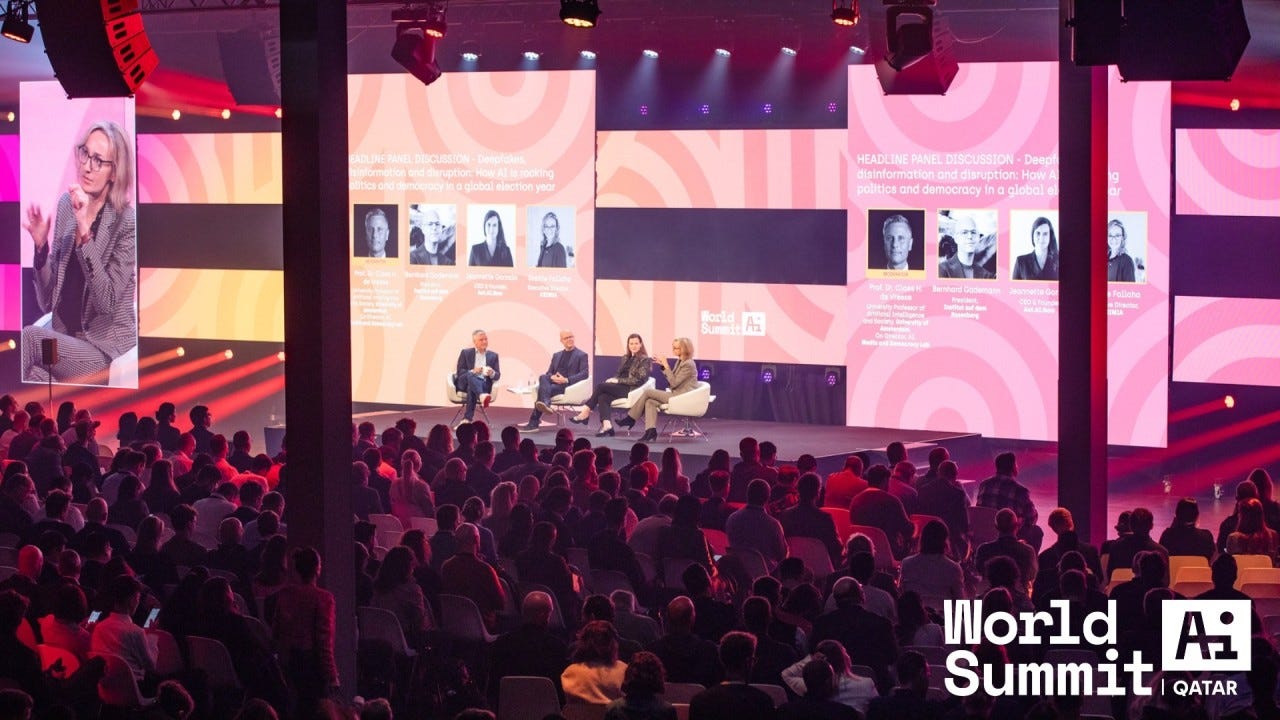
World Summit AI, held each October in or near Amsterdam, is a heavily commercial event. Talks mix vendor keynotes, customer case-studies and panel discussions on enterprise AI strategy.
The expo floor is packed with tools and platforms, and a start-up and investor track runs alongside.
Who attends
Enterprise AI leaders, start-up founders, investors, consultants and a smaller number of researchers. Conversations in the corridors are mostly about contracts, partnerships and hiring.
Why you should go
Go if you are selling or buying AI.
A start-up can meet a year’s worth of potential customers and investors in two days; a corporate team can sample the market without sitting through endless individual pitches.
Researchers go mainly to observe what is really being deployed, and how products are being framed.
Next Edition and Similar(ish) Conferences
World Summit AI takes place annually in October, with regional spin-offs appearing elsewhere. 2026 will be in Amsterdam, Netherlands, on 7 and 8 October.
Vendor conferences such as NVIDIA GTC (16–19 March, 2026, San Jose, California) or Salesforce’s Dreamforce (15–17 September, 2026, San Francisco) occupy a similar(ish) niche, but with a single company’s ecosystem at the centre.
Concluding Caveats
This is a deliberately selective list, skewed towards English-language, research-heavy events in Europe and North America. Many fast-growing regional conferences in Asia, Africa and Latin America do not appear here, and even within these five the quality of any given year can fluctuate sharply.
My perspective is also limited: any one attendee only ever sees a slice of a programme, filtered by their schedule, subfield and network.
And so treat this, then, as a map drawn from one working AI practitioner’s vantage point rather than an exhaustive ranking.
The practical question is still not which conference is “best” in the abstract, but which mix of people, incentives and conversations will most usefully challenge the way you think about AI.
Appendix: 📆 Calendar
Rest of 2025
NeurIPS 2025 Satellite, Mexico City, Mexico, 30 Nov–5 Dec 2025
NeurIPS 2025, San Diego, California, USA, 2–7 Dec 2025
2026 Jan-Mar
AAAI 2026, Singapore, 20–26 Jan 2026
NVIDIA GTC 2026, San Jose, California, USA, 16–19 Mar 2026
2026 Apr-Jun
ICLR 2026, Rio de Janeiro, Brazil, 23–27 April 2026
CVPR 2026, Denver, Colorado, USA, 3–7 Jun 2026
ACM FAccT 2026, Montreal, Canada, 20 Jun 2026
2026 Jul-Sep
ICML 2026, Seoul, Korea, 6 Jul 2026
AI for Good Global Summit 2026, Geneva, Switzerland, 7–10 Jul 2026
ECCV, Malmö, Sweden, 8–13 Sep 2026
Salesforce Dreamforce 2026, San Francisco, USA, 15–17 Sep 2026
2026 Oct-Dec
World Summit AI 2026, Amsterdam, Netherlands, 7–8 Oct 2026
2027
ICCV 2027, Nicosia, Cyprus, 24–25 Apr 2027